
St. George, UT · HVAC repair
AC Repair St. George, UT: Diagnosis and Repair for Systems That Won’t Cool
AC repair St. George homeowners need comes down to a short list of failures, and the desert makes certain ones far more common. Capacitors weaken in the heat. Condenser coils clog with red dust. Compressors that run for four or five months straight wear out sooner. If your air conditioner is running but the house is warm, or it won’t start, here is what is likely happening and what we do about it.
We handle more than cooling — see our complete HVAC repair in St. George services.
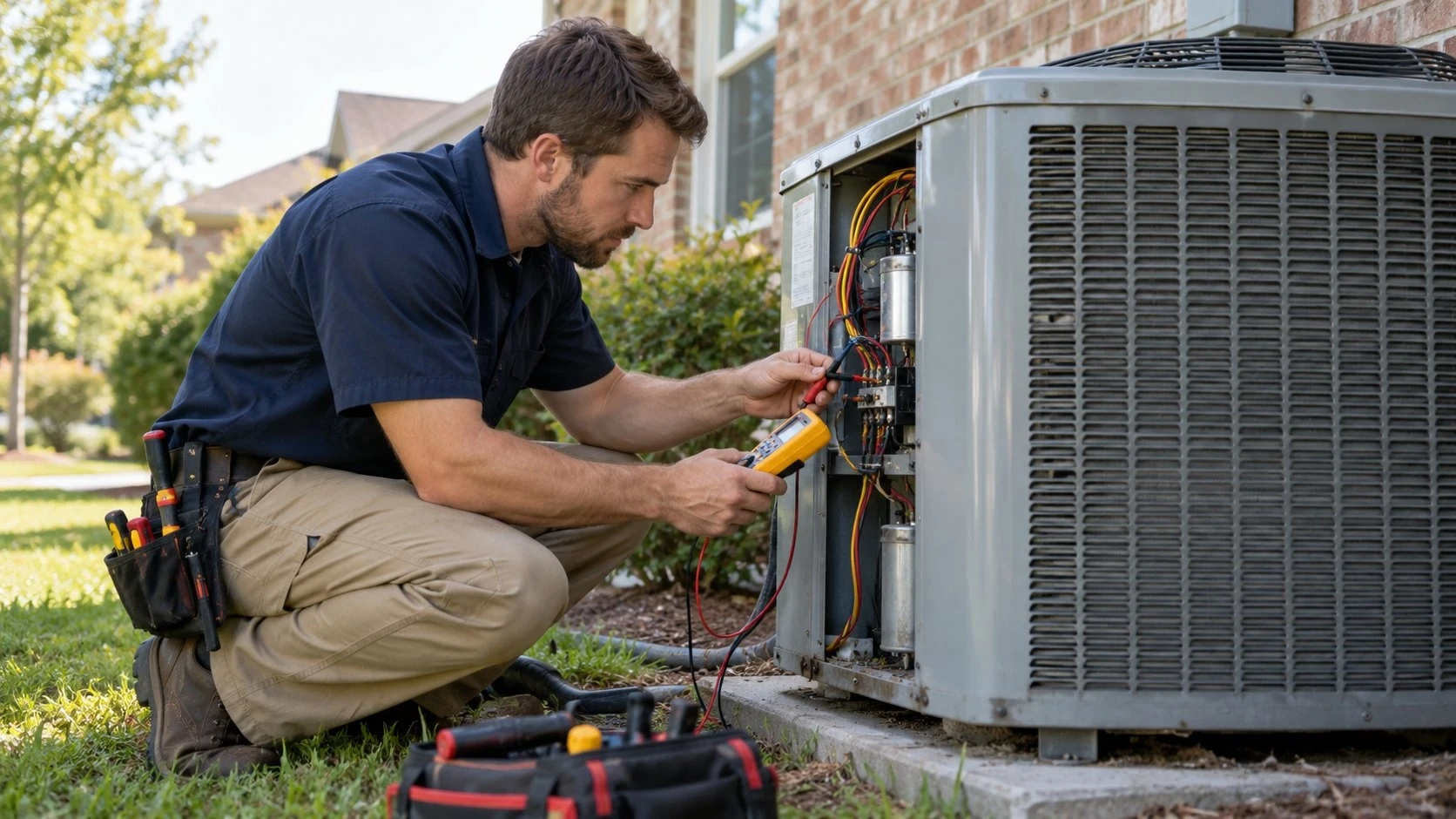
What Fails Most in a St. George AC
| Part | What goes wrong | How it shows up |
|---|---|---|
| Run capacitor | Weakens with heat and age | Humming outdoor unit, fan not spinning, compressor won’t start |
| Contactor | Contacts pit or stick | Unit won’t start or won’t shut off |
| Condenser fan motor | Bearings wear, motor overheats | Unit runs hot and trips on high pressure |
| Condenser coil | Dust and debris block airflow | Long runtimes, weak cooling, high bills |
| Evaporator coil | Dirt buildup or a refrigerant leak | Ice, warm air, water leaks |
| Condensate drain | Algae and sludge clog the line | Water at the air handler, shutoff from the float switch |
| Refrigerant circuit | Leak at a coil or joint | Gradual loss of cooling, ice |
| Compressor | Wear, electrical failure | Loud noise, tripping breaker, no cooling |
Why the Desert Changes the Picture
St. George averaged a record 107.9°F daytime high in July 2024, and highs reached 100°F every day from June 21 through at least August 6, according to KUER. Parts that would last a decade in a mild climate work much harder here. Dust from the Red Hills settles on the outdoor coil, and the attic, where many air handlers and ducts sit, is hotter than the air outside. A system that is slightly low on charge or slightly dirty shows it fast.
What to Check Before You Call
- Thermostat on Cool, set a few degrees below the room temperature.
- Filter: replace it if you can’t see light through it.
- Breaker: if it tripped once, reset it once. If it trips again, leave it off.
- Outdoor unit: look for ice, leaves or a stopped fan. Turn off the power at the disconnect before you touch anything.
- Indoor unit: if you see ice on the coil or line, switch the system to Off and run only the fan until it melts.
Don’t remove panels, add refrigerant or touch capacitors. They hold a charge even when the power is off.
What Happens on an AC Repair St. George Visit
A typical AC repair St. George visit follows one pattern. We tell you the arrival window when you call. The technician measures airflow, temperature drop, pressures and electrical readings, shows you the result and explains what it means before any repair starts. See How we diagnose an HVAC repair.
When Replacement Makes More Sense
A repair near half the cost of a new system on equipment past 10 to 15 years is usually the wrong spend. Read Repair or replace HVAC.
How an AC Works, So the Failures Make Sense
Your air conditioner doesn’t create cold. It moves heat. Refrigerant picks up heat at the indoor coil, carries it outside and releases it at the condenser. A fan pushes house air across the cold indoor coil, and another fan pulls outdoor air across the hot condenser. If any link is weak (dirty coil, failing fan, low charge, restricted airflow) the whole chain loses capacity, and capacity is already tight on a 105°F day.
Myths That Cost St. George Homeowners Money
- “Setting the thermostat to 65 will cool the house faster.” It won’t. The system cools at the same rate whatever the setting. It just runs longer.
- “Close the vents in empty rooms to save energy.” Closing many vents can raise duct pressure and reduce airflow across the coil, which can contribute to freezing and strain on the blower.
- “My AC needs a recharge every summer.” A sealed system doesn’t consume refrigerant. A recurring recharge means a leak.
- “A bigger unit will cool better.” An oversized system short cycles, which wears parts and cools the house unevenly. Sizing should come from a load calculation.
- “If it’s running, it’s fine.” A system can run all day and still be losing capacity to a dirty coil or a weak capacitor.
What a Tune-Up Would Have Caught
Many emergency calls trace to things a maintenance visit checks: a capacitor testing weak, a coil packed with dust, a drain line starting to clog and loose electrical connections. A cooling check in March or April is the cheapest way to avoid a July breakdown. See Maintenance plans.
Ducts and Attics
If your air handler and ducts are in the attic, they sit in air much hotter than the outdoor temperature. Leaky or poorly insulated ducts can waste a large share of the cooling you pay for. If some rooms stay several degrees warmer than others, the equipment may be fine and the ducts may be the problem. See Duct repair and sealing.
Signs It’s Time to Talk Replacement
- System older than about 12 to 15 years
- Repairs on three of the last four summers
- R-22 refrigerant
- Bills rising without changes in use
Our Repair or replace guide has the math.
Common AC Problems in St. George and What Causes Them
Most AC repair St. George calls start with one of six symptoms. Here is what each one usually means, what you can check safely and when to stop and call.
AC Freezing Up in St. George
Ice on the indoor coil or refrigerant line means the system is not moving heat properly. Turn cooling off, run the fan to thaw it and check the filter and vents. Common causes are a clogged filter, a dirty coil, a failing blower or a refrigerant leak, since refrigerant is never “used up.” Do not chip at the ice and do not keep running the AC with ice on it. If it freezes more than once, treat it as a repair.
AC Leaking Water
Water around the indoor unit is usually the condensate drain, not a broken AC. A clogged drain line, a cracked pan or a frozen coil that melts and overflows are the usual causes. Turn the system off, limit the damage and do not bypass a float switch. If water is near electrical parts or coming through a ceiling, shut off the breaker and call.
AC Not Turning On
- Nothing happens: check the thermostat batteries and mode, the AC and air handler breakers, the outdoor disconnect and the drain pan float switch.
- Fan runs, outdoor unit silent: often a failed capacitor or contactor, parts that fail in extreme heat. Capacitors hold a charge, so leave this to a technician.
- Breaker trips again: stop resetting it. That points to a short, a failing motor or a failed capacitor.
For a no-AC call in a heat wave, see emergency HVAC repair.
AC Running Constantly and High Cooling Bills
On a 110 degree afternoon a properly sized system may run for hours. It is a problem when the house keeps getting warmer, runtimes grow with no change in weather, or bills climb year over year. Typical causes are a dirty condenser or evaporator coil, low refrigerant, a clogged filter, leaky ducts in a hot attic, a failing capacitor or fan motor and aging equipment. We measure temperature drop, pressures and airflow and compare them to the manufacturer’s specifications. If the equipment tests healthy, the problem may be the ducts or the house, and we say so. See duct repair and the repair or replace guide.
Strange HVAC Noises
- Clicking: one click at startup is normal. Repeated clicking without starting points to a capacitor or contactor.
- Humming without starting: a failed capacitor or a stuck motor.
- Squealing: a worn motor bearing or slipping belt.
- Banging or rattling: loose panels, a loose fan blade or debris.
- Buzzing: electrical trouble or a failing contactor.
- Hissing: a possible refrigerant leak.
- Whistling: restricted airflow or duct leaks.
Shut the system off for burning smells, grinding metal, loud banging or a tripping breaker. A faint squeal ignored for two weeks can become a seized blower motor in mid-July.
Weak Airflow From the Vents
If every vent is weak, look at the filter, blower and coil. If one room is weak, look at the duct run serving it. Common causes are a dirty filter, a blocked return, a failing blower motor or capacitor, an iced or dirty coil, and kinked, crushed or leaking ducts. We test airflow at the registers and static pressure at the system, then follow the weak runs back to the cause. In one Desert Canyons home the answer was a kinked duct behind a knee wall, not a new system.
AC repair St. George visits usually begin with these six symptoms. Still not sure which one you have? Read how we diagnose an HVAC repair or the AC not cooling checklist. Seasonal HVAC maintenance catches many of these early.
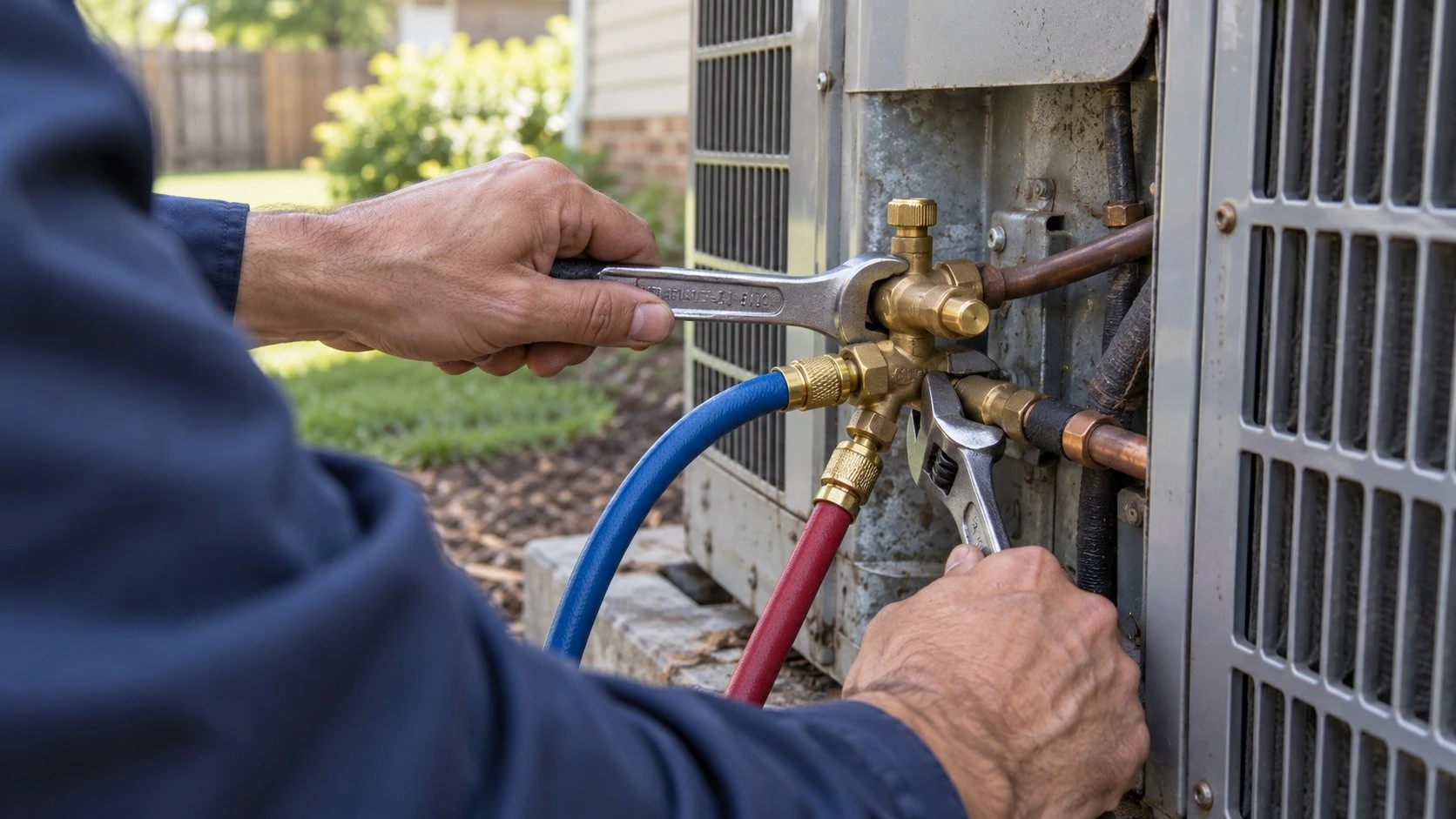
Refrigerant work is regulated: the EPA’s Section 608 program sets the rules for technicians who handle it.
Related Questions About AC Repair St. George
Why is there water around my indoor unit?
Usually a clogged condensate drain or a cracked drain pan. Clearing it is a modest repair. Ignoring it can damage ceilings or drywall.
Why does the outdoor fan run but not the compressor?
A failed capacitor or contactor is common. Don’t keep trying to start it, because repeated attempts can stress the compressor.
Should I cover my outdoor unit in winter?
Generally no. A tight cover can trap moisture and invite pests. Clear debris instead.
How often should I change the filter?
Check monthly in cooling season and replace when it looks dirty. Dust loads filters faster here than in many places.
Questions About AC Repair St. George
Why is my AC running but not cooling?
Start with the filter and outdoor coil. If both are clean, suspect low refrigerant or a failed fan motor or capacitor. See AC not cooling.
Is it normal for my AC to run all day in July?
On 105°F afternoons a correctly sized system may run for hours and still hold only a limited drop below the outdoor temperature. If the house keeps climbing, something is wrong.
Can low refrigerant be topped off?
Refrigerant is sealed in the system. If it is low, there is a leak. A technician should find and repair it before recharging.
How long does an AC last here?
Commonly 10 to 15 years, toward the short end with constant desert use.
Do you repair heat pumps and mini-splits too?
Yes. See Heat pump repair and Mini-split repair.
Need HVAC repair in St. George?
Call (435) 210-9732. You hear the arrival window before we dispatch.